 Apple Podcasts
  YouTube
  Spotify
  Overcast
  Amazon Music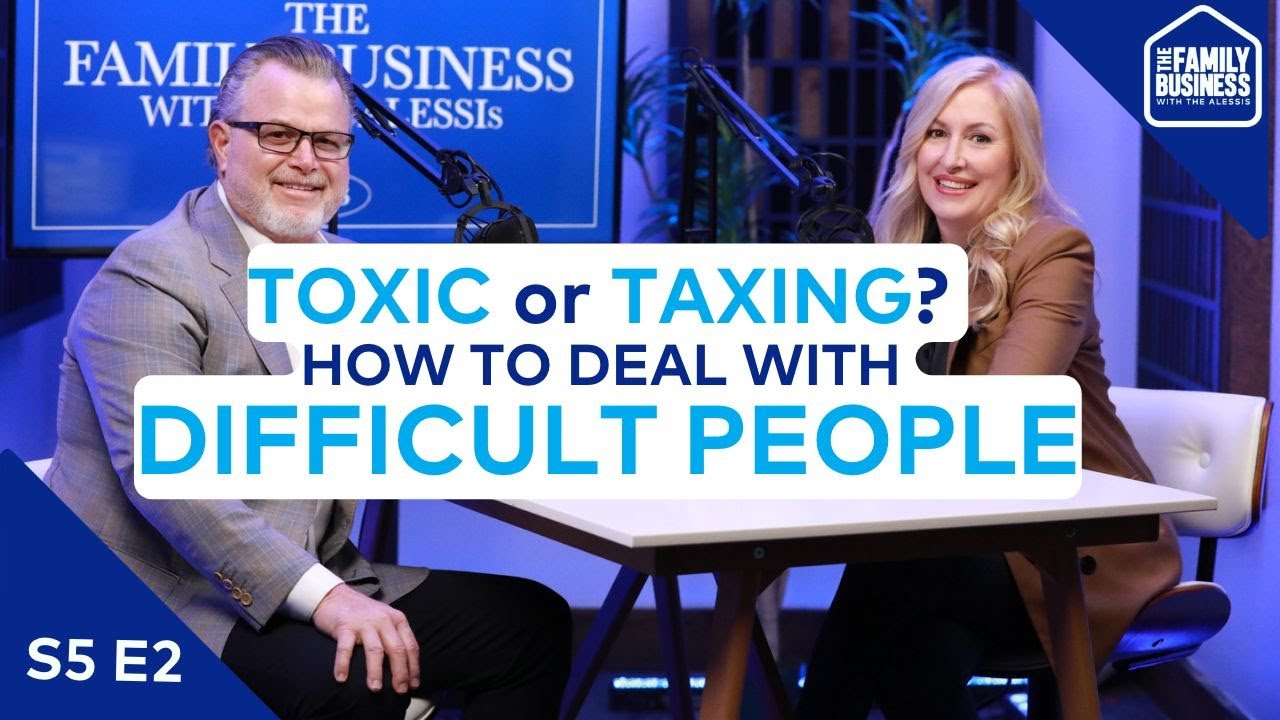
Are the difficult people in your life truly toxic, or are they just taxing? The Alessis are here to help you figure out when to tolerate difficult people and when to cut ties.


You know that person in your life that's a major pain. But does that mean you should cut them off?
Are some difficult people in your life worth tolerating, even when they cause you headaches?
In this episode, Steve and Mary Alessi help you figure out when a family relationship or friendship is simply a taxing one that you can tolerate, or if it's toxic and requires setting boundaries.
By applying these smart and practical strategies, you can finally let go of any confusion or guilt when dealing with a difficult person in your life!
Join our family business every week as we talk about life, and help you build a great future with your family, no matter what business you are in.
New episodes are uploaded every Wednesday!
More Resources
Get your copy of the new book by Steve Alessi, “Forty-Two: A Guide to Finishing Well when You Thought You Were Finished”
Connect with Us on YouTube
Don't forget to LIKE and SUBSCRIBE to our YouTube channel!
Follow Us on Social!
Learn More about Metro Life Church:
00:00 - Intro to Szn 5 Ep 2
01:25 - Taxing or Toxic - What's The Difference?
04:45 - Why Every Herd Needs an A**
11:32 - How Difficult People Can Help You
12:43 - Is *** a Curse Word?
13:38 - More Taxing Topics
17:17 - When Taxing Becomes Toxic
21:16 - Why Toxic People Never Change
26:02 - George and Tammy: A Toxic Example
29:37 - Closing Thoughts
Intro to Szn 5 Ep 2
SPEAKER_02Hello and welcome to another episode of the Family Business with the Alesssies. And today in the podcast booth is Steve and Mary Alesi. We're going to be talking about family today because family is everybody's business.
SPEAKER_01Yes, they are.
SPEAKER_02Wow, Mary, we are in our fifth season.
SPEAKER_01I can't believe it. That's awesome.
SPEAKER_02A lot of fun. Yeah, I'm really proud of the way this is unfolding, and I believe it's been a real uh help. We're getting some good replies and comments from people.
SPEAKER_01People are catching on.
SPEAKER_02Talking about the podcast and how it's helping them. And it's funny because you hear it from some of the most unlikely people, right?
SPEAKER_01Yeah.
SPEAKER_02You don't you you don't think those are podcasters or in the audience, but they're out there, and um, it's good to be able to hear from them and uh to hear that the podcast is being a real blessing to them. So today uh we're gonna talk about a subject. I think it's pretty good. How you been, by the way? Feeling good?
SPEAKER_01I'm feeling good. Thank God. I'm trying to get my diet, exercise, all that in order, bringing my sugars down.
SPEAKER_02Yeah.
SPEAKER_01So, you know, how about you?
SPEAKER_02I've been great. Great. You're doing the same. So I'm really feeling good. All right. Um
Taxing or Toxic - What's The Difference?
SPEAKER_02here's here's the topic of conversation today. I think this one's pretty cool. It's knowing the difference between a toxic family member or a taxing uh family member. Yeah. The difference between a toxic and taxing family member. Right off the top, what are you thinking?
SPEAKER_01I'm thinking that you there might be somebody at work too that you have to be able to tell the difference between toxic and taxing. Are we gonna talk specifically about family?
SPEAKER_02Nope. No.
SPEAKER_01So we can talk in general.
SPEAKER_02Well, I think what happens is this, and here's why I'd like to address it. Because we have um we have labeled pretty much anybody that gives us headaches as toxic.
SPEAKER_01Oh yeah. And I think that's unfair. Yeah, it's ridiculous.
SPEAKER_02Uh at the same time, people that are toxic need we we need to know what to do with them.
SPEAKER_01Right.
SPEAKER_02So there is a difference between the two. And as I I kind of lay it out this way, more or less, you know, the taxing family member or the taxing per person is maybe somebody that gives you headaches.
SPEAKER_01Right.
SPEAKER_02Somebody that just um You can't depend on or they're laid or well, they're they're they do things differently than you, or they make you feel uncomfortable because maybe they're driver, or maybe they're not. Maybe they're more laid back and you're ready to get going forward and you're ready to really make some things happen there. Um taxing people are not bad people.
SPEAKER_01No.
SPEAKER_02And we should be aware that they are all around us, and we should see them as such and not necessarily eliminate them from our lives.
SPEAKER_01No. I think this happens in our lives. I I do like this subject. I was kind of rolling around about it before we got into the podcast booth. The more I process it, I realize in my 20s and in my 30s, I needed to know the difference between somebody who was just taxing in my life, and we all question do we keep this person in our life? Do we not keep this person in our life? How much do, you know, they're driving me crazy, they're pushing me, or they do things differently than me, but they're family. Or there's somebody that's just in my life I'm going to see, and I have to know where to put this person. So it's a super healthy conversation to have.
SPEAKER_03Yeah.
SPEAKER_01Um, because I think all of us would really, in our pettiness, would rather cut a whole lot of people off because they irritate us.
SPEAKER_02They're just too toxic.
SPEAKER_01And we call them toxic. It's like the word trauma and triggered. You know, we are overusing words that do not fit our circumstance.
SPEAKER_03Yeah.
SPEAKER_01So it's it's not good for us and it's not good for our relationships because we're gonna have difficulty developing our relational skills. That's something you develop. That's a muscle that you grow. Um, learning how to deal with difficult people, people that push you, people, where do they fall, you know, on the spreadsheet? Where do they fall? This person. No, that's good. We have this conversation with our kids in ministry. We have this conversation with our staff. We've had this conversation with each other over the years.
SPEAKER_03Yep.
SPEAKER_01You know, where do we say, okay, this far and no farther? Or maybe there's something about this person that's irritating me, but it's it's good for me.
Why Every Herd Needs an A**
SPEAKER_02We uh use the analogy of something we learned when we first started going into Georgia and looking around, seeing our property. And then as we'd go, we saw fields of cows. You remember that? And then we started to notice that in the fields of cows where there was herds of cows, you would also see a donkey. That's right.
SPEAKER_01This is such a good analogy.
SPEAKER_02Yeah. So we're like, what's a donkey doing in that with those cows? So I talked to this old farmer one day, and he says, Yeah, man, that's that's very intentional from the farmer. So why is that? He says, Well, the uh only real enemy to the coyote is a donkey. So what happens with the cows is these are birthing cows, they're not necessarily uh milk cows, dairy cows. These are birthing cows. So what'll happen is when those cows get ready to give birth, the afterbirth attracts the coyote. And wolves in some areas, right, and wolves, the predator, and what'll happen is they'll attack the baby calf.
SPEAKER_03Right.
SPEAKER_02So the farmer knows, let me put a donkey out there, because the donkey is the the enemy, the natural enemy to the wolf or to the coyote. So he'll put one for every, who knows, 50 cows or so in his field. So when you and I learned that, I was like, okay, here's the deal. Every herd needs an ass. Which one are you? Which, if you're in a herd, uh-huh, if you look around and you don't see an ass, you be with it. And we just crack ourselves up, don't we? Oh, great conversation. So and the and the point there is if you have an ass, if you have difficult person, a taxing person that you don't get along with, you know. And so, well, you don't realize they could just be a taxing person, right? But they protect the herd.
SPEAKER_01So true.
SPEAKER_02I know we have it on our staff. I look around the staff, and if okay, we got a very a few people that are ta uh taxing. They're not toxic. They couldn't work here if they were toxic. No, no. But they're taxing. Yeah, they're just they're they they're high drivers. There's they're drama filled. They focus on the drama. Everything is a new story of someone that's irritated them, and you're like, oh my gosh, we have to have this conversation with this person. And I'm already, after 10 minutes, ready to move on because I just I I don't need that uh in my my world. But that taxing person can play a good role because if they are aggressive, right, if they're taxing, quite frankly, somebody else comes around and tries to attack what we have going on here as a family and as a staff and as a ministry, that's the first person that's going to go to battle for us.
SPEAKER_01Right.
SPEAKER_02We want them in their post.
SPEAKER_01And sometimes that that person that is that has that quality about them, the drama goes along with the personality because they see the high, they they see the worst possible scenarios. So they're thinking in a different posture of protection, and nobody's gonna come in here and take and steal. And so we take the good with the bad are the things that maybe drive us crazy or whatever. That personality, you there's good stuff and there's bad stuff. You know, just just like there's other personalities that might not be the ass and the herd, um, that can drive us crazy too, too laid back, way too non-aggressive. I mean, there's so many different personality types. But for the sake of this conversation, when we're talking about the the high-level people that push you, push you, push you that we get irritated with, there's really more good in that than there is bad. Because when we can we can look back and we see those people that over the landscape of our lives or years together, working together, or our family, they've really got our backs. And that's that's where, you know, teaching our our four young adult kids now as they're growing up, six, including the in-laws. And they'll be with the in-laws and there'll be more. But it's been it one of the the greatest blessings for me is to be able to help our kids know um who to who to have more grace for. Way before they even know to have grace. Because we can see it coming. We, you know, people are the same. We're just we're in little different groups, but we're all we're all basically the same. You have passive aggressive, you have aggressive aggressive, you have pushiers, you have sitters, you have climbers, you have quitters. I mean, it's we don't really have a lot of categories we fall into. But it is super important to know the people that are in your life that God has put there to be a blessing to you, that you don't burn a bridge on your blessing just because you've got to learn to have chemistry with them. And you've got to learn who they are and how you guys work together, or where to put some distance and take them in. Uh, I'll give you an example. Your m your mother told our girls one day we were talking about uh family members and mother-in-laws, and she was talking about your father's mother, Madeline.
SPEAKER_03Yeah.
SPEAKER_01And that woman, your grandma. She was an Italian, a little Italian lady, barely spoke English, and her sons were her everything. So the poor daughter-in-laws never had a chance. Yeah. I don't care who they were. They she could have married Queen Elizabeth and she still would not have been enough for her son. And so we we asked her, How did you deal with it? How did you handle her? She was so taxing, almost toxic.
SPEAKER_02She was toxic.
SPEAKER_01Okay, well, it's your grandmother.
SPEAKER_02If it wasn't for the pizza, she would be never never.
SPEAKER_01But she gave such great advice. She said, in small amounts, in small amounts. She, you know, to keep her heart right, because it was family, she just learned how to take every once a week in small amounts with that person so that you she wouldn't keep having run-ins and feeling terrible about herself and feeling insecure about herself.
SPEAKER_03Yeah.
SPEAKER_01Um, and that, believe it or not, that little nugget of truth is so helpful to your to your mind and to your heart to know how to deal with people and how to manage people that might be pushing.
SPEAKER_02Yeah,
How Difficult People Can Help You
SPEAKER_02taxing people are are are just that. They're gonna put a little more weight on you, a little bit more pressure on you. That some of them, you know, being around taxing people, Mary, sometimes makes us even better.
SPEAKER_03It does.
SPEAKER_02It makes us look up, makes us try harder. They may challenge us, they may say things the wrong way, but yet, you know, it irritates us. And then we go home and we're thinking about it. And then three or four days later we make certain decisions because we're like, man, maybe I should do this. They they cause you to think sometimes taxing people are not bad people. No, you just have to be a little bit more secure in yourself when you're hanging out with some taxing people.
SPEAKER_01Yeah, especially family members.
SPEAKER_02Yeah. And you got them.
SPEAKER_01Yeah.
SPEAKER_02They they're there.
SPEAKER_01Right.
SPEAKER_02And there's no way you're going to go around in the world and all these different types of personalities that are there and you not run into a taxing person.
SPEAKER_03Yeah.
SPEAKER_02And what you cannot do is run away from them. Yeah. Take them in small dose, like mom says. And but when they're in your family, you you you have to invite them to the party. Yeah. They're going to be there at the baby shower. They are. And you just might as well, you know, be ready for them, give them their special corner and uh help them deal with it. By the way,
Is *** a Curse Word?
SPEAKER_02I realized we have cussed on this podcast.
SPEAKER_01You said it three times, I said it once. It's four times.
SPEAKER_02Wow, you used to never cuss.
SPEAKER_01Well, I married you. It's been 35 years.
SPEAKER_02And introduced you. To bad habits. To one three-lettered bad word.
SPEAKER_01It's in the Bible.
SPEAKER_02It is. Yeah. So that wasn't a cuss word, by the way. When we taught our kids when they were young what cuss words were, that was one of the one things we used as an example. Because it's not a cuss word if it's not if it's used when you're talking about a donkey. It's only a cuss word when you want to put somebody down. That's when it was a cuss word.
SPEAKER_01Okay. Send in your comments. Tell us what you think.
SPEAKER_02Yeah, what are cuss words? And there's a couple others like that. Like do you think?
SPEAKER_01Well, you know, wait, hold on a second. Let's not go there. Um, but you you think about it from that perspective. Maybe you have a family member that can't control their tongue.
SPEAKER_02Hmm.
SPEAKER_01Right?
More Taxing Topics
SPEAKER_02Right.
SPEAKER_01Can you see what I'm saying? See where I'm going? Politics. Okay, politics. Politics are bad too.
SPEAKER_02If it's politics, it may be a taxing conversation. That's all it is.
SPEAKER_01But they're not a toxic person.
SPEAKER_02They're not a toxic person.
SPEAKER_01Maybe, and maybe it's a religion issue too. And they're not toxic. It's just taxing. You know, um, there are people that are more predispositioned, that's a word, to be negative. And I know that negative people, I I my personality, I can't handle too much negativity even coming out of my own mouth. So I really can't handle being around somebody that's just always finds the negative, the negative, the negative. And I found this great quote. It says, negative people need drama like oxygen. Stay positive and it will take their breath away. So don't give up who you are being around a taxing person. Yeah. Yeah. You know, you don't have to cut them off. Stay positive. Put cotton in your ears. You're not going to change them. You're not going to fix them. Find a way to make it funny and move on. Something else it's not good to do with a taxing family member, whatever category they fall into. If it's a political difference or religious difference, or they just cuss all the time, or they tease you. Because that's the thing about family. Family can get raw with each other, you know? And you're on you're on the job and you're running things, and then you get around your family and you're just, you're nobody. And uh it can irritate you and stir you up and trigger you for sure. But what we don't want to do is cut off the people that are going to be at our funeral eventually, probably the only ones that are going to be at our funeral, which is our family, um, to know that you can just stay positive and put people in a category where you still love them. And hey, it takes a lot of self-control. That's not something you just learn from one conversation to the next or from one enlightenment to the next. It's something you have to practice and rehearse and bite sizes with those people, little small amounts of time.
SPEAKER_03Yeah.
SPEAKER_01And then don't lose yourself in trying to change a person that you don't have the ability to change.
SPEAKER_02Yeah. Well, the taxing person is somebody that's just they're it's normal. They just do things different than you, and and it wears on you. So it, yeah, it's taxing on your mind and the all of that. You got it. But you're a big boy, you're a big girl, you can handle the taxing person. Right. They're difficult, you can handle them. All right.
SPEAKER_01Well, but we hear so much in this generation, and there's quotes all over the internet: only be around people that celebrate you. Well, I think that's very dangerous personally. That's not going to work. It doesn't work. So being around difficult people.
SPEAKER_02That's a narcissist.
SPEAKER_01Well, yeah. I mean, I think fans the flame of that. Or I mean, only everybody, well, guess what? All you're gonna do is stay in a relationship until they stop celebrating you. Yeah, then you're gonna move on to somebody else. So pass the test of the taxing person and know that it's as much on us to love them regardless as it is on them to love us regardless.
SPEAKER_02Keeps you humble, man.
SPEAKER_01Man, it keeps you humble.
SPEAKER_02Yeah.
SPEAKER_01Because we would it would be so much easier to quit on that person. Yeah. Go, that's it. I I'm done. I'm not going to Christmas. I'm not going to Thanksgiving. I'm not, I'm not going to do it. I'm not going to put myself in my in that position. And and and we've all been there. We've all been there. Where how much is too much? When is it? When are we done? And and that's a that's a fine line because once it does go too far and it does move into the realm of toxic or unhealthy, that's a different conversation.
SPEAKER_02Well, then let's move into that.
SPEAKER_01Yeah.
SPEAKER_02What about the toxic person? Here, and I would define the toxic person as a
When Taxing Becomes Toxic
SPEAKER_02person that hurts you.
SPEAKER_01Yeah.
SPEAKER_02And and that's why it seeks to hurt you. They really do. Yeah. They they they seek to hurt you. And that's the person that um you got to realize hurt people, hurt people. Yes. And there's nothing you're going to be able to do to keep them from hurting you. No. And that's where now you need to draw a line in the sand. And you need to say, all right, with all due respect, you stay on your side, and I stay on my side.
SPEAKER_03Yeah.
SPEAKER_02Which now means, from a toxic person's standpoint, it's best not to have a relationship with them at all.
SPEAKER_01At all.
SPEAKER_02And that's that's really hard, especially if it's family.
SPEAKER_01Right.
SPEAKER_02Um, because you think, well, I gotta love my family, and everybody's got the black sheep of the family, and so on, and so forth. And maybe that's true to a certain degree, but you have to get to a place where you start saying, All right, we can't invite them to the party if every time they come to the party, they're gonna get so drunk that now all of a sudden somebody's gonna, they're gonna end up in a fight with somebody. They ruin every event. They ruin everything.
SPEAKER_01Yeah, you can't do it.
SPEAKER_02Now you've just crossed over the line of taxing to toxic, and where you put up with the taxing person, you don't put up with the toxic person. And I know it's hard for people to hear us say that because we're pastors and you know we're Christians and we're we're supposed to love everybody. But I I I even can see in the scripture with Jesus, he's like, you know what? You go do what you got to do, Judas. Yeah, I'm not hanging with you, I'm not gonna follow you down to where ultimately you're gonna hurt me. No, I you go do what you got to do, I'm gonna do what I got to do. That's right. That's where I think the different has difference has to lie. You have to put up boundaries to protect yourself from toxic people.
SPEAKER_01You do. And can I also just add to this? We've I think we talked about this in one of our past podcasts about toxic people. And if you've not listened to that, we encourage you to go back and listen to all of our podcasts on toxic natures and people and relationships, because I think they were some of our top listened to podcasts.
SPEAKER_03Yeah.
SPEAKER_01And this is a this is a conversation that needs to be had a lot. But toxic people know where your weaknesses are and they prey upon that and your insecurity. And usually they'll come to the table, to the party, to the event, whatever, with their mind already set to stir the pot, either aggressively or to create drama. Rarely do toxic people sit back and say, next time I'm gonna do better. I am not gonna hurt my sister, my brother, I'm not gonna hurt my daughter or my son. I am gonna go in there. They don't even think from the rational perspective of we can sit down and have a normal conversation where we both meet in the middle and it's healthy. They're toxic for a reason. There's brokenness, there's hurt in them. And at some point in your life, you have to decide where you have to protect your heart. And I heard a great quote. I've lived by this, but I like how it said um people can stay in your heart, but they don't necessarily have to stay in your life. So I loved my father, he was in my heart as my father, but I couldn't keep him in my life because there was just too much damage that was continually happening. And what I found with time and space and not being bitter and angry, staying in a place of unforgiveness, I had to just resolve I can't fix that, I can't change that. And he's one of, we've had other toxic people in our lives throughout our lives. But time and space doesn't necessarily heal that wound, but it helps me cool off and think more from the perspective of what's right versus caught up in the drama and the storm that they're going through.
SPEAKER_03Yeah.
SPEAKER_01So space is always priority number one for the toxic person.
SPEAKER_02I think the problem with uh toxic people is this, you know, I'm responsible every day to get up and look in the mirror and make sure that I'm
Why Toxic People Never Change
SPEAKER_02the best version of myself every day. That's my responsibility. That's not your responsibility, is my wife. That's my responsibility, my relationship with God. It's very personal. It's that relationship with Him that's gonna help drive me to be better. So if I see things that are wrong in me, New Year's resolutions, we always talk about them. We just had, you know, uh employee reviews talking about what we're gonna do differently. Every employee, Mary, as well as you and I as leaders, we all say we want to do this better this year.
SPEAKER_03Yeah.
SPEAKER_02So what we're saying is we're taking responsibility because we see areas of our life that aren't as good as they could be. That's right. So we're gonna take responsibility to do our best to better those areas. That's right. The top Toxic person refuses to look in the mirror and say, I'm going to get better. So they want to keep going on and on in their brokenness and blame others. The problem with this younger generation today is nobody wants to take responsibility for themselves. They want to keep blaming everybody else: the mom, the dad, the the ex, the the government, uh, the man. They always are placing on other people. And it's multi-generational. Someone will go back many generations to point the finger and say, that person did this to me. Well, hey, every person has the same opportunity that you and I have in the morning to say, I'm gonna do better today.
SPEAKER_01That's it.
SPEAKER_02I'm gonna be better today. The new year, every person has that opportunity to say, I'm gonna do better this year. That's exactly right. So if you were broken, one, you get healed.
SPEAKER_03Yeah.
SPEAKER_02And once you get healed, how do I get healed? Well, there's God, He'll heal you. Uh, there's counselors, they'll help you walk through it. Great resources, uh, the church environment, come around, prayer. We're gonna get you healed. All right. God's gonna step in. People are gonna be there to counsel you through it, our connect groups here at our place. Hey, there's a lot of avenues for you to get healed. Great books out there you can read, great tapes you can listen to, book on tape and audiobooks, you can listen to all that. You're gonna find healing. So the toxic person refuses to do it. Yes. And they want to continue to point the finger. Well, if you're not gonna take responsibility for yourself and our relationship, then I have to.
SPEAKER_03Yeah.
SPEAKER_02And just like I have to eliminate certain habits in my life that I enjoy but are not good for me, I'm gonna have to eliminate you relationally if you're toxic because you're not good for me.
SPEAKER_03Yes.
SPEAKER_02Now, I'm gonna say it, but I better back it up because hurt people are gonna hurt people. And I can't ever trust if you're toxic, your lips are moving, you're not telling me the truth. You're lying. So I gotta be able to see the fruit on the tree before I start thinking you've been in uh healed and you're worthy of a relationship. Is it hard?
SPEAKER_01Yes, it's hard.
SPEAKER_02Very hard because we love some of those people that are toxic. Some of them raised us.
SPEAKER_01Yeah.
SPEAKER_02And that's hurtful to be able to back have to back away from them.
SPEAKER_01We don't know how to disconnect. We don't know how, and if we can, are are are we allowed to do that? Because does that make it worse? I don't want to be the person that makes it worse. The toxic person comes in at here, and if I uh draw the boundaries, then I'm here. Okay, I'm worse than them. No, you don't they have the a a good picture of a toxic person, as you and I both know, is somebody that's at odds with themselves. And so now you come in, they're at odds with themselves. They're literally in a boxing match with themselves all the time with their pain, their frustration, their inability to cry uncle within themselves, and you walk into that, and now they just put you right in the middle of their boxing match with themselves. And so you get, especially if you're a daughter, if you're a son, if you're a spouse, if you're a parent, however, whatever the relational way it works for you. But if you step into the middle of that, you're gonna get beat up. And you can choose to say, Well, I I'm not in the mood for a fight right now. And it's not good for me, and it's not healthy for me. And distance yourself from that person. And guilt should never be a reason that you redeem a relationship. Yeah, it's never guilt. Guilt is never a motivator, it will always lead you right off the cliff. It's right or it's wrong. That's it.
SPEAKER_02The toxic person is gonna hurt the innocent person more, and it's a simple person, and they're they're drawn to that. We we've watched this series a couple of times, and it's a sad series right now on television, showtime. I think it is George and Tammy. Oh my gosh, George Jones, Tammy Winnet.
SPEAKER_01Tammy Winnet.
SPEAKER_02Um
George and Tammy: A Toxic Example
SPEAKER_02he she, beautiful singer, sweetheart, you know, had her own issues early on, but they fell in love with each other. She should have known right away when he showed up to eat at her house for dinner with her husband that he was a predator.
SPEAKER_01Yeah, yeah.
SPEAKER_02He was a ends up taking her away from that. But his drinking, he would, he would, he had everything going for him, Mary. Things were so perfect for him. He's got a great voice, great career. Married to this beautiful woman, but he couldn't stop drinking because he had these, he would call them his demons, you know. He spiritualized it. It's his demons, all right. But he couldn't get fixed, he couldn't stop drinking. He would supposed to, I mean, the guy was was was penalized. He he he had so much in debt to paying for fines for getting drunk and not showing up at his performances. So he had con contractual agreements and he wouldn't even show up to him because he would drink himself into a stupor.
SPEAKER_03Yeah.
SPEAKER_02And it got to a place one time he shows up with a gun, he pulls a gun out, starts shooting the house up. She runs for her life. The sad thing was every time he would do that, she kept believing she can love him through it.
SPEAKER_01Yes.
SPEAKER_02Until it finally destroyed her.
SPEAKER_01Oh man.
SPEAKER_02And she ended up dying before him. Now the guy, you know, was restored. He came out of it. He got rid of drinking, met a wonderful woman, ended up marrying, staying married with her the longest of all the wives that he married. Point was, she couldn't fix him.
SPEAKER_03No.
SPEAKER_02It took something else to help him get fixed. He was toxic and it destroyed her.
SPEAKER_01That's right.
SPEAKER_02You can't be in a relationship with toxic people if they're not willing to get help, get sober, stay sober, get help, quit being abusive, not come out to hurt you. If they're not healed, they're going to continue to hurt you. And hey, that's a person you want to put the boundaries up and stay as far away as possible. And don't be guilted into inviting them to all of your family events because there may be family. Don't do that. They're going to hurt you. They're going to ruin it. And you're going to say to yourself when it's over, I should have gone with my gut instinct.
SPEAKER_01Yeah. You can you can predict what's going to happen if they're not better. And it's interesting because this morning I actually read about one of the young ladies in our church who she put on on our feed to really pray because her father is getting out of rehab. And that she's concerned about it because she just got married and now they're they're trying to have a baby. And she's like, please pray for my father because he's getting out of rehab. I think it's like after six months or so, it's a long time. And, you know, I'm praying that this is the time. And you know, I I prayed and listened a little prayer, but the reality of that is she could be the worst person that he attaches himself to the minute he gets out of rehab because she's the daughter. And no matter how strong she tries to be with him, it will she'll never be strong enough because she's the daughter. It's the way he sees her. And there's only so much she can do. And she's better off to just love her father, pray for him, call him, like go on with her life as long as she can to give him years to be sober. And I know that may sound really crazy to some people, and I know we're not talking about addictions, but most of the time, oh, quite a few toxic people have addictions.
SPEAKER_02Yeah. Well, we're gonna come to a close of this podcast. And Mary and I were very flippant about certain comments or we make light, we joke about taxing people and then toxic
Closing Thoughts
SPEAKER_02people, but yet we also realize this is not easy. This is very, very difficult to help navigate. If we can shed some light on how to do it, then that's what we are trying to do in this podcast. But I'll tell you, some of you have to make a tough choice when it comes to dealing with toxic people. We know it's not easy, and that's why, as religious leaders, we're going to be praying for you. And if you need help, please see a counselor.
SPEAKER_01Yes.
SPEAKER_02If you're part of what we do here in our church at Metro Life Church in Miami, uh reach out to us. We have a great wellness program that we can help walk you through making such tough, difficult decisions. We know it's not easy. So that's what this episode of the Family Business was about. Uh, we try to get in everybody's business because business, family, that is, is everybody's business. Thanks for joining us today.
SPEAKER_00You've just enjoyed another episode of the Family Business Podcast with the Alessis, and we can't thank you enough for being a part of our podience today. Now that you've learned more about us, here's how you can join in in the family business. First, make sure you're following our podcast right now and download this episode so you can hear it at any time. Second, think of someone you know that might need or enjoy this episode and share it with them. You'll be helping them and helping us to spread the word about the family business. Third, go to AlesiFamily Business.com and tap the Ask the Alessies button. This is really cool. You can use it to record a voicemail comment or question, and we can add your voice to our conversations. Finally, while you're on our page, tap the reviews tab and you'll see a link to leave a review on Apple Podcasts. We love reading your reviews and we might even share them on the show. Thanks again for joining us, and we'll see you next time at the Family Business with the Alesssies because family is everybody's business.